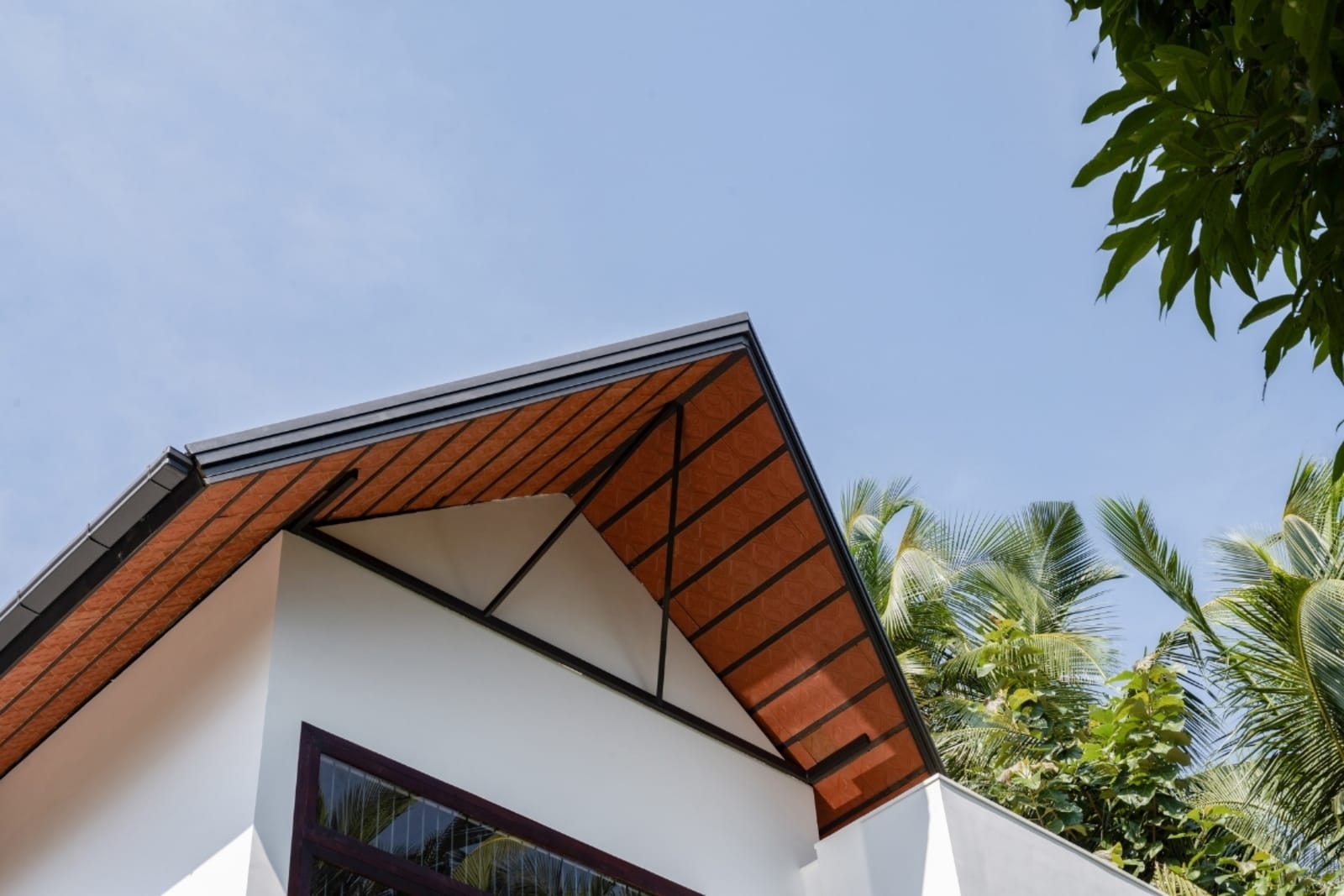
Designing for the Monsoon: Resilient Details for Contemporary Kerala Homes
Kerala’s monsoon is not a problem to be solved — it is a defining condition that good architecture must embrace. Heavy, prolonged rainfall, high humidity, and driving winds demand thoughtful detailing at every scale, from roof overhangs to wall materials and transitional spaces.
In our practice, we design for the monsoon from the beginning. A well-detailed contemporary home should not merely survive the rains; it should remain comfortable, dry, and beautiful throughout the season.
The Monsoon Challenge in Framed Construction
Framed structures with large windows and open plans introduce new considerations:
- More glass and wider openings increase the risk of water ingress if not properly detailed.
- Reduced wall thickness (possible because walls are non-load-bearing) requires careful attention to junctions and flashings.
- Greater emphasis on roof design, overhangs, and drainage becomes essential.
Yet the framed approach also offers advantages: cleaner lines for deep overhangs, easier integration of modern drainage, and the ability to use the best wall materials for moisture management without structural compromise.
Core Principles of Monsoon-Responsive Design
1. Generous Overhangs and Protective Layers
Deep roof overhangs (1.5–2.5 m where needed) are non-negotiable on south and west faces. We combine them with secondary layers — verandas, chajjas, and pergolas — that create multiple lines of defence against driving rain.
2. The Protective Role of Transitional Spaces
Verandas and courtyards are not just aesthetic or cooling devices; they are critical monsoon buffers.
- A well-designed veranda acts as a rain-protected outdoor room.
- Courtyards with proper drainage and slightly raised floors prevent water from entering adjacent spaces.
- These spaces allow the house to “breathe” while keeping the interior dry.
3. Breathable Wall Materials
Laterite and Wienerberger Porotherm blocks both perform well in monsoon conditions because they allow moisture vapour to pass through rather than trapping it. This breathability, combined with good overhangs and ventilation, prevents the dampness and mould issues common in poorly detailed modern construction.
We avoid fully sealed, impermeable wall systems in Kerala wherever possible.
4. Careful Detailing at Every Junction
The difference between a home that stays dry and one that leaks often comes down to details:
- Proper flashing at window and door heads
- Sloped sills with adequate projection
- Well-designed roof-to-wall junctions
- Positive drainage away from the building
- Expansion joints and movement accommodation in longer spans
In framed construction these details are easier to execute cleanly because the structure is independent of the infill walls.
5. Roof Design and Drainage
Sloping roofs with adequate pitch, generous overhangs, and well-placed gutters and downpipes remain the most reliable approach in Kerala. Flat roofs require exceptional waterproofing and are generally less forgiving in our climate.
Material Choices That Support Monsoon Performance
- Laterite: Excellent breathability and proven long-term performance in exposed conditions when properly detailed.
- Wire-cut bricks: Good durability; we often use them in protected or semi-protected locations.
- Wienerberger Porotherm: Lightweight, insulating, and breathable — very suitable for infill in framed monsoon-resilient designs.
- Lime-based plasters and natural finishes: Allow walls to breathe and develop character over time rather than failing when moisture is present.
Lessons from Practice
In recent projects we have found that the homes that perform best during monsoon are those where:
The roof and overhang strategy is generous from the start
Transitional spaces (verandas, covered walkways, courtyards) are sized and located to buffer the main living areas
Wall materials are chosen for breathability rather than maximum impermeability
Every penetration and junction is detailed with care and redundancy
These principles do not add significant cost when considered early; they simply require design attention.
Looking Ahead
As Kerala experiences more intense rainfall events, resilience is becoming as important as thermal comfort. The best contemporary architecture in the region does not fight the monsoon — it accommodates it gracefully through intelligent form, generous protection, breathable materials, and meticulous detailing.
A home that stays dry, comfortable, and low-maintenance during months of heavy rain is not just practical. It is a quiet expression of respect for the place where it is built.
When framed structures, smart wall materials, and monsoon-responsive details come together, the result is architecture that feels at home in Kerala — in every season.
Keywords: monsoon design kerala, rain protection kerala architecture, veranda courtyard monsoon performance, breathable walls kerala, water management tropical homes, laterite in monsoon, framed structure monsoon detailing, climate resilient kerala homes